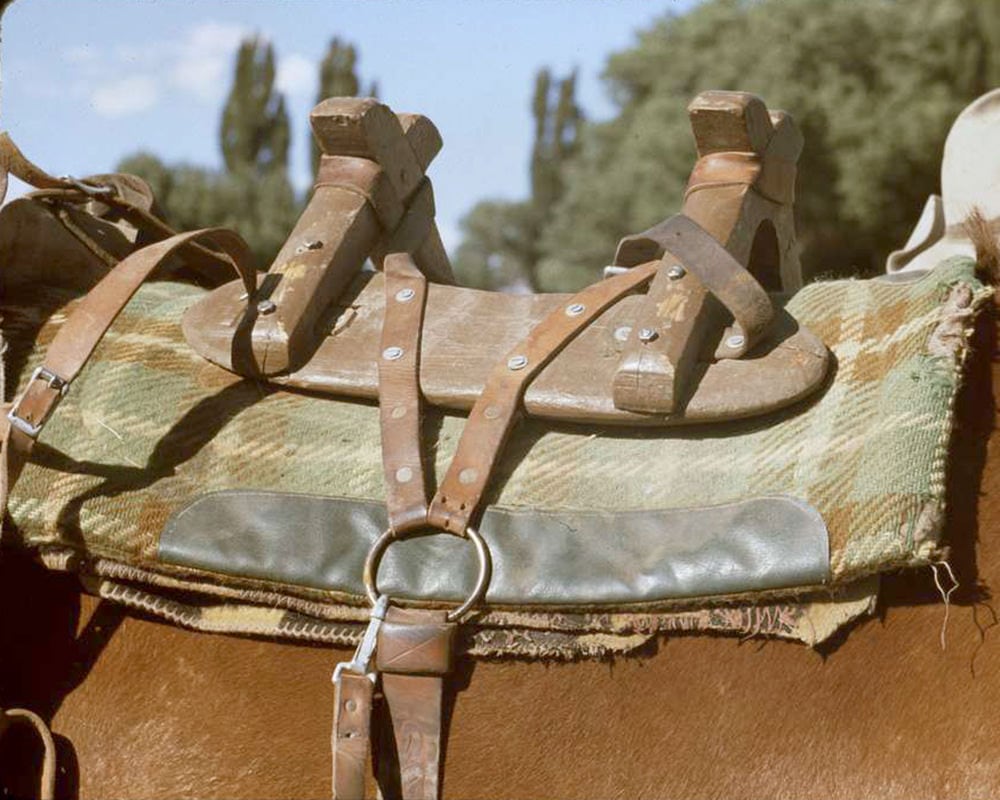
savoir où le bât blesse

The French idiom “savoir où le bât blesse” means literally “to know where the pack-saddle pinches.” What it really means is “to know someone’s secret problems” or “to know someone’s hidden pain.”

A pack saddle is a device, usually made from wood, placed on the back of an animal, to enable it to transport goods.

This saying comes from the experience of knowing that a pack saddle, when badly placed on a donkey or other beast of burden, can wound the animal. These wounds are hidden beneath the pack saddle and are only visible once the saddle is removed. These hidden wounds can make the animal irritable or sad, just like a person with hidden problems.

This idiom dates back to the 15th century.

Equivalent English sayings include “that’s where the shoe pinches,” or “to know where the shoe pinches.”

Don’t miss new articles!

Get 1 email a week with new articles about French

We don’t spam! Read more in our privacy policy

Similar Posts

  • Thing

    In French, there are several words used to refer to “thing.” Each has its nuances and specific contexts where it’s most appropriate. Here’s a guide to the different French words for “thing.” Chose The most common word for “thing” is une chose. It is used broadly and can refer to just about any object or…

  • | |

    Devant

    The French word “devant” can be used as a preposition, as an adverb, or as a noun. Preposition As a preposition, “devant” means “in front of,” “ahead of” or “before.” Adverb As an adverb, “devant” means “in front,” “at the front,” or “ahead.” Noun As a masculine noun, “le devant” means “the front.”

  • décrocher le cocotier

    “Décrocher le cocotier” means literally “to unhook the coconut tree” or “to take down the coconut tree.” In English, it means “to achieve one’s goals, to win a prize, or to triumph.” An equivalent English expression would be “to hit the jackpot.” The saying dates from the 19th century. It refers to greasy pole competitions in…

  • chargé

    The French adjective “chargé” has several meanings and can be used in various contexts. Amongst others, it can mean “loaded,” “busy,” “charged” and “heavy.” Here are some usage examples: Etymology of “charger”