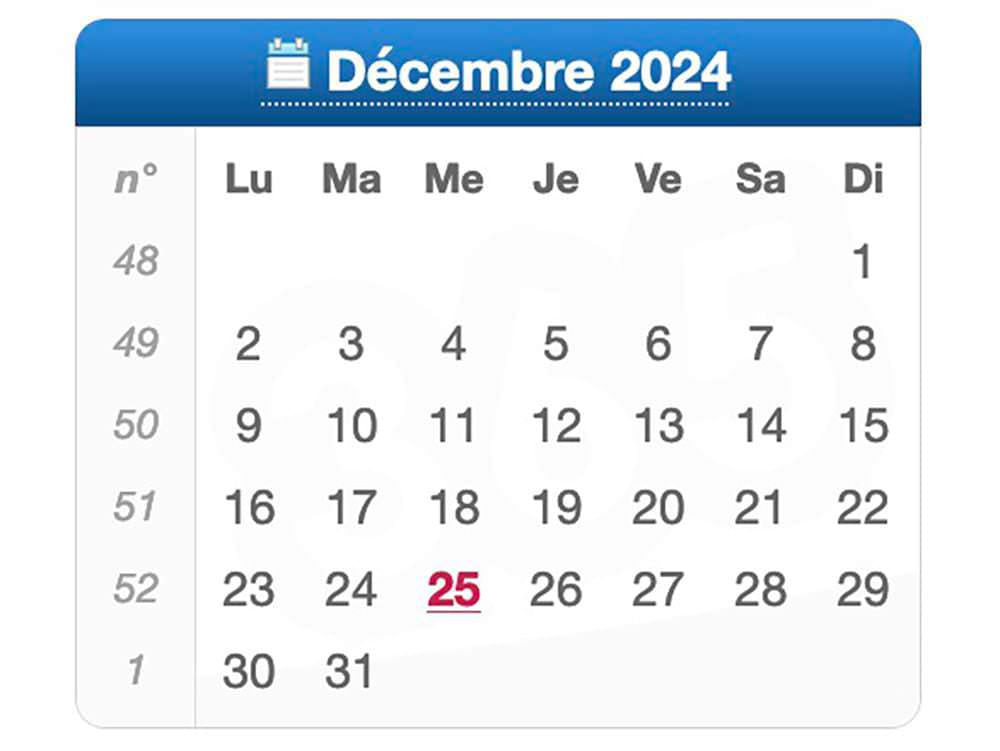
Days of the week

It’s important to know the days of the week in French. Each day has an English translation. Each day also has an original meaning, which may sometimes help you to remember it.

FrenchEnglishOriginal French meaning
lundiMondayDay of the Moon
mardiTuesdayDay of Mars
mercrediWednesdayDay of Mercury
jeudiThursdayDay of Jove (Jupiter)
vendrediFridayDay of Venus
samediSaturdayDay of the Sabbath
dimancheSundayDay of the Lord

Don’t miss new articles!

Get 1 email a week with new articles about French

We don’t spam! Read more in our privacy policy

Similar Posts

  • maint

    The French adjective “maint” means “many,” “many a,” “numerous” or “manifold.” It is a little archaic and is most commonly used in a literary way, although some still use it in everyday speech. People tend to prefer more modern words such as “beaucoup,” “nombreux,” “plusieurs,” or more familiarly, “plein de.” As an adjective, “maint” must…

  • à couteaux tirés

    The French saying “à couteaux tirés” means literally “at knives drawn,” or “with knives drawn.” What it actually means is a situation of open war, or great tension, or great hostility, or diametrically opposed. The idiom dates back to the end of the 17th century. Historically, arguments were often “resolved” with knives or daggers. So…

  • | |

    derrière

    The French word “derrière” can function either as a preposition, as an adverb or as a noun. Depending on which one of these three parts of speech it is being used as, it can mean “behind,” “after,” “shortly after,” “afterwards,” “bottom,” or “back.” It is the opposite of “devant,” discussed in this blog post. Preposition…

  • mine de rien

    “Mine de rien” is a popular French expression that is used in everyday conversations. Literally translated, it means “appearance of nothing,” “expression of nothing,” or “look of nothing,” but its true meaning goes beyond its literal interpretation. This expression is often used to describe someone’s behavior or attitude when they are doing something in a…

  • Verb: s’occuper de

    Exploring the French Verb “s’occuper de”: Usage, Etymology, and Examples 1. Understanding “s’occuper de” “S’occuper de” is a reflexive verb in French, which means it always requires a reflexive pronoun. The reflexive pronoun “se” changes according to the subject of the sentence: 2. Usages of “s’occuper de” a) Taking Care of Something or Someone One…

  • le pouvoir

    The French masculine noun “le pouvoir” translates to “power” or “authority” in English. It comes from the French verb “pouvoir,” meaning “to be able,” or “can.” “Le pouvoir” has its roots in the Latin word “potere,” which means “to be able” or “to have the right.” This Latin term evolved into the Old French “povoir” before…