days of the week
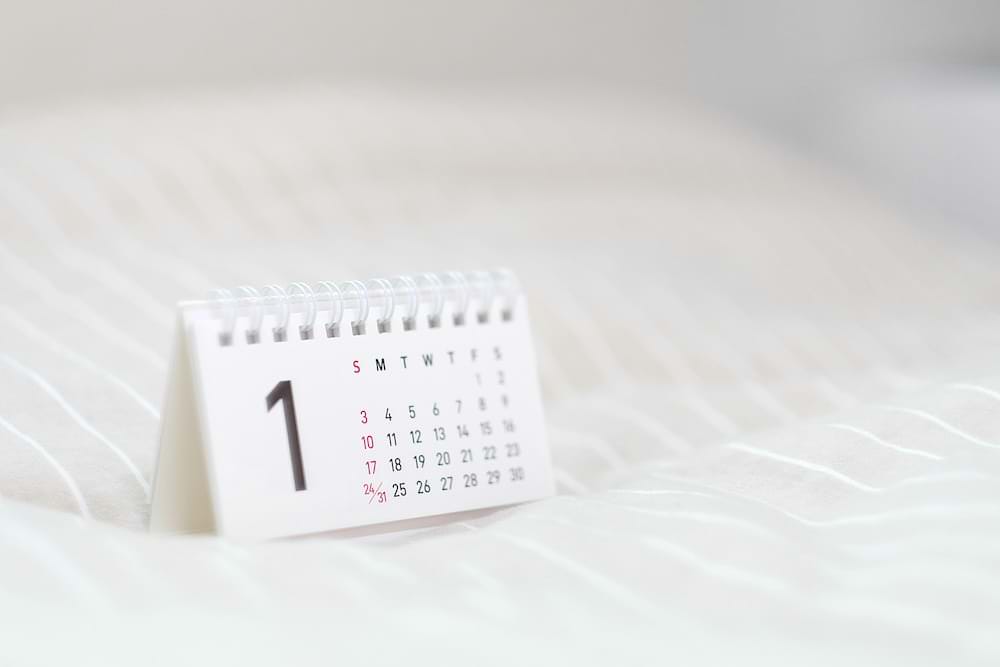
French uses a seven-day week aligned with the international standard, beginning on Monday. The French names come largely from Latin and preserve references to classical deities and celestial bodies. The following table shows the days in French and English.
| French | English |
|---|---|
| lundi | Monday |
| mardi | Tuesday |
| mercredi | Wednesday |
| jeudi | Thursday |
| vendredi | Friday |
| samedi | Saturday |
| dimanche | Sunday |
General usage
French days of the week are not capitalised unless they begin a sentence. They are masculine nouns. They take the definite article le to express habitual actions.
Examples:
- Je viens le lundi.
I come on Mondays. - Il travaille le mercredi.
He works on Wednesdays. - Nous partons samedi.
We are leaving on Saturday. - Elle revient dimanche.
She is coming back on Sunday.
Lundi
Lundi comes from Latin dies Lunae, the day of the Moon. The word preserves the reference to Luna, the Roman moon goddess.
Common uses:
- Lundi prochain, je commence un nouveau travail.
Next Monday, I start a new job. - Le lundi, le musée est fermé.
On Mondays, the museum is closed.
Mardi
Mardi derives from Latin dies Martis, the day of Mars, the Roman god of war.
Common uses:
- Mardi, nous avons un rendez-vous important.
On Tuesday, we have an important appointment. - Je fais du sport le mardi.
I exercise on Tuesdays.
Mercredi
Mercredi comes from Latin dies Mercurii, the day of Mercury, the messenger god associated with communication and travel.
Common uses:
- Mercredi, les enfants n’ont pas classe l’après-midi.
On Wednesday, the children have no school in the afternoon. - Il vient me voir mercredi prochain.
He is coming to see me next Wednesday.
Jeudi
Jeudi comes from Latin dies Jovis, the day of Jupiter (Jove), the chief Roman deity.
Common uses:
- Jeudi, je dois aller à Paris.
On Thursday, I must go to Paris. - Le jeudi, elle prend des cours de danse.
On Thursdays, she takes dance classes.
Vendredi
Vendredi comes from Latin dies Veneris, the day of Venus, the Roman goddess of love.
Common uses:
- Vendredi, on dîne chez mes parents.
On Friday, we are dining at my parents’ place. - Elle finit tôt le vendredi.
She finishes early on Fridays.
Samedi
Samedi has a different pattern. It comes from Latin dies Sabbati, the day of the Sabbath. The word travelled through Old French forms such as samedi, samedy and samedit.
Common uses:
- Samedi, nous faisons les courses.
On Saturday, we do the shopping. - Ils sortent souvent le samedi soir.
They often go out on Saturday evenings.
Dimanche
Dimanche originates from Latin dies Dominica, the day of the Lord. This reflects the Christian tradition of Sunday worship.
Common uses:
- Dimanche, tout est calme en ville.
On Sunday, everything is quiet in town. - Le dimanche, je me repose.
On Sundays, I rest.
Habitual vs one-off usage
To distinguish repeated weekly actions from one-off events, French uses the definite article le for habitual activities and no article for specific occurrences.
Examples:
- Je travaille le lundi.
I work on Mondays. - Je travaille lundi.
I am working this Monday.
Prepositions and articles with days
French uses no preposition when stating a specific day. The definite article le marks habitual actions. Other prepositions appear in set expressions or to indicate time frames.
Key points
• no preposition for a specific day: use the day name alone.
• use le + day for habitual or repeated actions.
• use à in colloquial farewells or appointments: À lundi = see you Monday.
• use en semaine to mean “during the week.”
• use partir en week-end to say “go away for the weekend.”
• use dans to express an offset into the future (in + time).
• use pendant to express duration across a period.
Usage examples
- Mercredi, j’ai une réunion.
On Wednesday, I have a meeting. - Le mercredi, je fais du sport.
On Wednesdays, I exercise. - À mercredi.
See you on Wednesday. - En semaine, je me lève tôt.
During the week, I get up early. - Je pars en week-end vendredi.
I am leaving for the weekend on Friday. - Dans trois jours, ce sera lundi.
In three days, it will be Monday. - Pendant la semaine, le magasin est ouvert tard.
During the week, the shop is open late.
Notes on alternatives and emphasis
• Ce before a day pinpoints the coming instance: Ce mercredi, je ne peux pas. (This Wednesday I cannot.)
Summary
French day names trace back to Latin, with six of the seven linked to Roman deities or celestial bodies. All are masculine and not capitalised unless they begin a sentence. Le indicates habitual actions. Specific dates omit the article. Many practical phrases rely on these patterns, which remain consistent across modern usage.