date
To talk about the date in French, you need to know numbers, the days of the week, the months of the year, plus a few other terms.
Days of the week
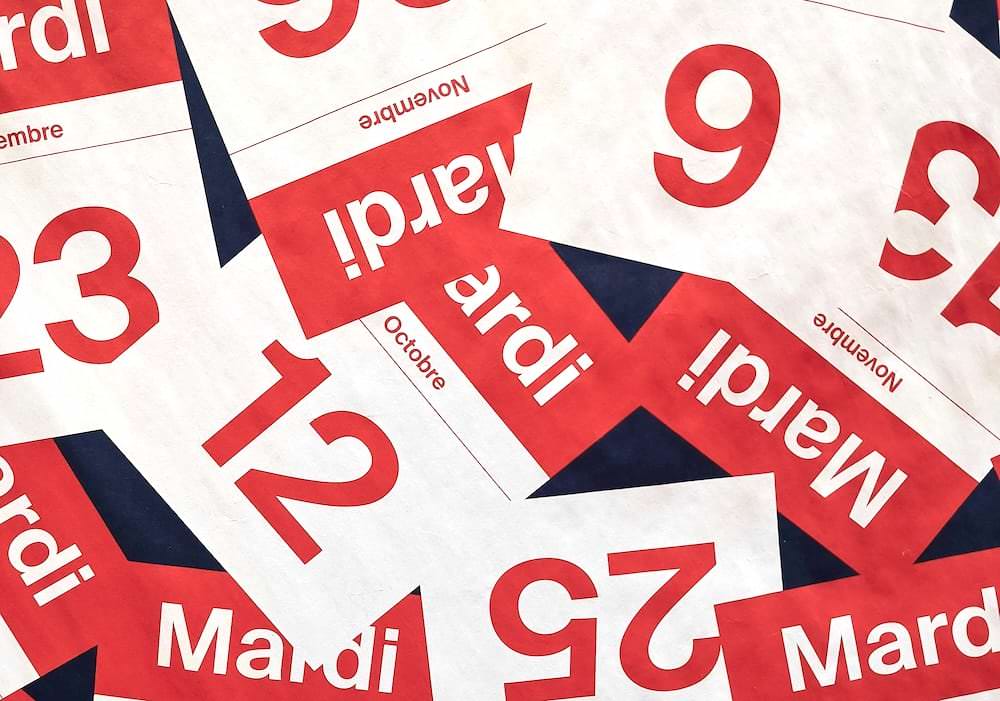
The french week starts on Monday. Days are not capitalised unless they start a sentence.
- lundi “Monday”
- mardi “Tuesday”
- mercredi “Wednesday”
- jeudi “Thursday”
- vendredi “Friday”
- samedi “Saturday”
- dimanche “Sunday”
To say “every Monday” or “on Mondays,” use le.
- Je travaille le lundi. “I work on Mondays.” (every Monday)
- Il vient le mardi. “He comes on Tuesdays.” (every Tuesday)
For a specific day, you can also just use the day alone.
- On se voit samedi. “We’ll see each other on Saturday.”
- On se voit le samedi. “We see each other on Saturdays. (ie every Saturday)”
- C’est fermé dimanche. “It’s closed on Sunday.”
- C’est fermé le dimanche. “It’s closed on Sundays. (ie every Sunday)”
Months of the year
Months are also not capitalised.
- janvier “January”
- février “February”
- mars “March”
- avril “April”
- mai “May”
- juin “June”
- juillet “July”
- août “August”
- septembre “September”
- octobre “October”
- novembre “November”
- décembre “December”
To say “in May,” use en.
- En mai, ils font ce qu’ils veulent. “In May, they do what they want.”
- Nous partons en juillet. “We leave in July.”
For months that start with a vowel sound, it is still en.
- En avril, ne te découvre pas d’un fil. “In April, do not shed a single thread.” (a french saying)
Date
To ask the date, you say:
- Quelle est la date aujourd’hui ? “What is the date today?”
- On est quel jour ? “What day is it?” (more casual)
To give the date, you use C’est or On est or Nous sommes. The day comes before the month. You do not capitalise them.
- C’est le 3 mai. “It’s May 3rd.”
- On est le 15 août. “It’s August 15th.”
- Nous sommes le 1er janvier. “It’s January 1st.”
For the first day of the month, you say le premier.
- Le premier mai “May 1st”
- Le premier avril “April 1st” (april fools’ day)
For all other days, you use the number.
- Le deux octobre “October 2nd”
- Le trente et un décembre “December 31st”
- Le quatorze juillet “July 14th” (Bastille Day in English, but the 14 July in French)
Writing the date
When writing the date, the French write the day, then the month, then the year. They use slashes or dots.
- 3/5/2024 or 3.5.2024 means May 3rd, 2024.
- 14/7/2023 is July 14th, 2023.
Specific dates
To refer to a specific date like “Monday, 12th april,” you have two common ways to say it. Both are correct.
The structures
- Day + le + number + month
- Le + day + number + month
Examples
- On se voit lundi le 12 avril. “We’ll see each other on monday, 12th april.”
- On se voit le lundi 12 avril. “We’ll see each other on monday, 12th april.”
- Je pars mercredi le 3 mai. “I leave on wednesday, may 3rd.”
- Je pars le mercredi 3 mai. “I leave on wednesday, may 3rd.”
- La fête est samedi le 15 juin. “The party is on saturday, june 15th.”
- La fête est le samedi 15 juin. “The party is on saturday, june 15th.”
- Il arrive jeudi le 1er octobre. “He arrives on thursday, october 1st.” (remember premier for the first)
- Il arrive le jeudi 1er octobre. “He arrives on thursday, october 1st.”
The le belongs to the date
In le lundi 12 avril, the le is the same le you always use before a number in a date. It does not make it “every monday.” The full date makes it specific.
Another form
You can also put the date first, then the day. It is less common but correct.
- On se voit le 12 avril, lundi. “We’ll see each other on monday, the 12th of april.”
When the day and date are the same
If the day is the same as the date, you can just say the date. People understand.
- On se voit le 12 avril. “We’ll see each other on april 12th.”
Year
To say the year, you say en plus the year.
- Je suis né en 1990. “I was born in 1990.”
- Il est arrivé en 2022. “He arrived in 2022.”
For the year 2000 and after, you can say it two ways.
- deux mille vingt-trois “2023”
- vingt vingt-trois “2023” (common in speech)
For dates with the year, you add the year after the month.
- C’est le 15 mars 2025. “It’s March 15th, 2025.”
- Nous sommes le 2 janvier 2024. “It’s January 2nd, 2024.”
For years before 2000, you say them like numbers in the thousands. You break them into two parts. The first part is the hundreds. The second part is the rest.
- 1996 = mille neuf cent quatre-vingt-seize.
- 1789 = mille sept cent quatre-vingt-neuf (the year of the Revolution)
- 1968 = mille neuf cent soixante-huit (the year of the student protests)
- 1900 = mille neuf cents (You add the *s* to cent because it is plural and there is no number after it. This is the only time cent gets an *s* in a year.)
Important dates and holidays
Some dates have special names.
- Le jour de l’An “New Year’s Day” (January 1st)
- La Saint-Valentin “Valentine’s Day” (February 14th)
- Le poisson d’avril “April Fools’ Day” (April 1st)
- La Toussaint “All Saints’ Day” (November 1st)
- Noël “Christmas” (December 25th)
For saints’ days, you say la Saint-Jean (St. John’s Day) or la Saint-Nicolas (St. Nicholas’ Day). It is feminine even for male saints.
Common phrases
- Quel jour sommes-nous ? “What day is it?”
- Aujourd’hui, c’est lundi. “Today is Monday.”
- Demain, c’est mardi. “Tomorrow is Tuesday.”
- Hier, c’était dimanche. “Yesterday was Sunday.”
- Elle prie tous les dimanches. “She prays every Sunday.”
- Nous partons en vacances début juillet. “We leave on vacation at the beginning of July.”
- Ils reviennent à la mi-août. “They come back in the middle of August.”
- On se voit fin septembre. “We’ll see each other at the end of September.”
- Je travaille du lundi au vendredi. “I work from Monday to Friday.”
- Le magasin est fermé le lundi. “The store is closed on Mondays.” (regularly)
Summary
- Days and months are not capitalised in french.
- Use le with numbers for the date: le trois mai.
- For the first, use le premier.
- In writing, put day/month/year.
- Use en for months and years.
- Use C’est, On est, or Nous sommes to state the date.