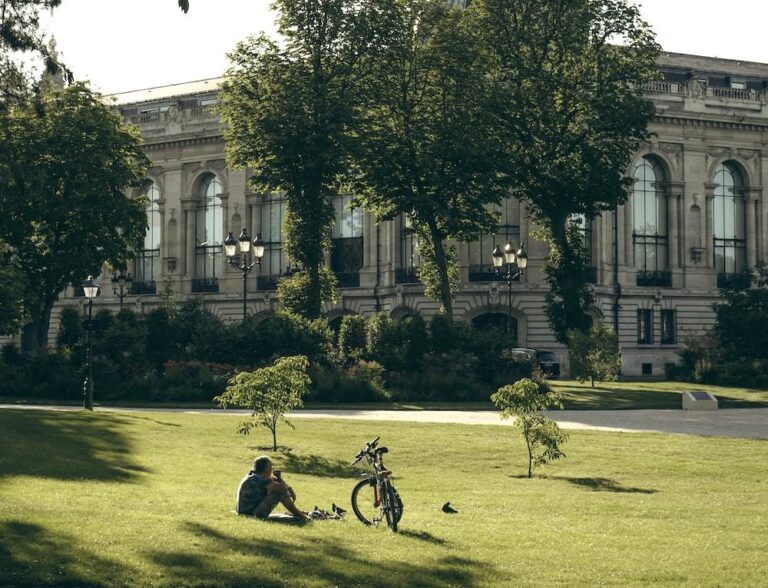
au milieu de

The phrase “au milieu de” is a common French prepositional phrase that literally translates to “in the middle of” or “amid.” It consists of three parts: the preposition “à” combined with the definite article “le” (contracted to “au”), the noun “milieu,” and the preposition “de.”

Usage and Meanings:

1. Physical Location

The most straightforward use indicates physical position:

  • “La table est au milieu de la pièce.” (The table is in the middle of the room.)
  • “Il s’est arrêté au milieu de la route.” (He stopped in the middle of the road.)

2. Temporal Context

It can describe a point in time:

  • “Au milieu de la nuit” (In the middle of the night)
  • “Au milieu du repas” (During the meal/in the middle of the meal)

3. Figurative Usage

The phrase often appears in metaphorical contexts:

  • “Au milieu des difficultés” (Amid difficulties)
  • “Se retrouver au milieu d’une controverse” (To find oneself in the midst of controversy)

Common Variations:

  • “En plein milieu de” – Emphasizes being right in the middle
  • “Par le milieu” – Through the middle
  • “Au beau milieu de” – Right in the middle of (often used for emphasis)

Etymology and Historical Development:

The word “milieu” comes from the Latin “medius locus,” meaning “middle place.” The Latin “medius” evolved into the Old French “mi,” which we still see in words like “midi” (noon/midday). During the 12th century, French combined “mi” with “lieu” (place, from Latin “locus”) to form “milieu,” creating a more specific term for “middle.”

Don’t miss new articles!

Get 1 email a week with new articles about French

We don’t spam! Read more in our privacy policy

Similar Posts

  • asseoir & s’asseoir

    The French verbs asseoir and s’asseoir both mean “to seat” or “to sit.” The verb asseoir is mostly used in the reflexive form s’asseoir, which means “to sit down.” It is an irregular verb with more than one accepted conjugation pattern. In modern French, the most commonly used form is based on the root assié-…

  • direct object pronouns

    In French, a direct object is a noun that receives the action of the verb directly, without a preposition. The French term is complément d’objet direct, often abbreviated as COD. To avoid repeating the noun, we use direct object pronouns to replace it. A pronoun is a word that replaces a noun (ie a naming…

  • hypothetical situations

    In French, when expressing hypothetical situations about the present or future, we use the imperfect tense (imparfait) in the “si” clause and the present conditional (conditionnel présent) in the result clause. This structure is used when the condition is contrary to reality or unlikely in the present. The imperfect tense sets up the hypothetical situation,…

  • loger vs se loger

    “Loger” is a transitive verb meaning to accommodate, house, or provide lodging for someone or something. The subject provides housing to the object. “Se loger” is a reflexive verb meaning to find accommodation, to house oneself, or to settle somewhere. The subject finds or secures housing for themselves. Key structural differences Loger (transitive) This verb…

  • intéresser

    The French verb intéresser belongs to the first group of regular verbs ending in -er. It means to interest or to be interested in. Although it resembles the English verb “to interest” in meaning, its grammatical structure differs significantly. 1. To interest someone: To attract someone’s attention or curiosity In this sense, intéresser means to…

  • rappeler

    The French verb rappeler is a versatile verb with several meanings, depending on whether it is used in its regular (non-reflexive) form or its reflexive form se rappeler. While both forms relate to memory and reminding, they are used in different grammatical structures and carry different meanings. The Non-Reflexive Verb “Rappeler” In its non-reflexive form,…

Leave a Reply

Your email address will not be published. Required fields are marked *