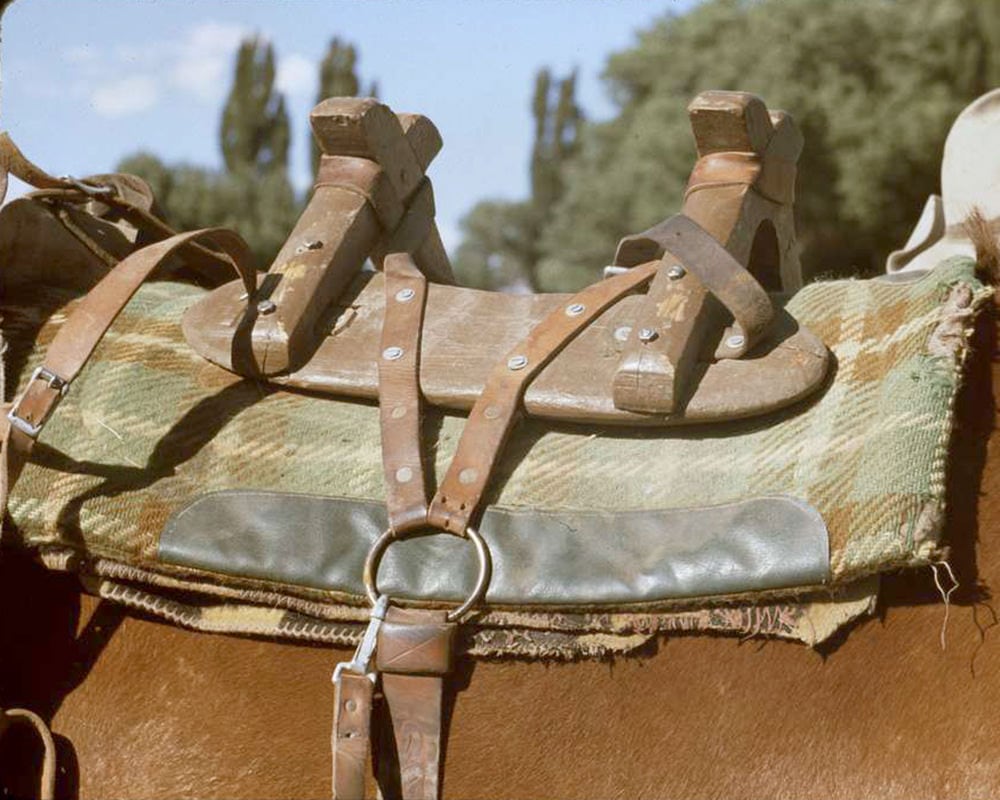
savoir où le bât blesse

The French idiom “savoir où le bât blesse” means literally “to know where the pack-saddle pinches.” What it really means is “to know someone’s secret problems” or “to know someone’s hidden pain.”

A pack saddle is a device, usually made from wood, placed on the back of an animal, to enable it to transport goods.

This saying comes from the experience of knowing that a pack saddle, when badly placed on a donkey or other beast of burden, can wound the animal. These wounds are hidden beneath the pack saddle and are only visible once the saddle is removed. These hidden wounds can make the animal irritable or sad, just like a person with hidden problems.

This idiom dates back to the 15th century.

Equivalent English sayings include “that’s where the shoe pinches,” or “to know where the shoe pinches.”


Don’t miss new articles!

Get 1 email a week with new articles about French

We don’t spam! Read more in our privacy policy

Similar Posts

  • g pronunciation

    The letter “g” can be pronounced in two different ways in French. It can be hard, like the first “g” in the word “garage,” which is both a French word and an English word. Or it can be soft, like the last “g” in “garage.” How do you know whether a “g” will be hard…

  • verb: craindre

    Meanings of “Craindre”: The French verb “craindre” primarily translates to “to fear” or “to be afraid.” However, its meanings extend beyond mere fear, encompassing a spectrum of related emotions: Conjugation in Present and Passé Composé: “Craindre” belongs to the third group of French verbs, which are often irregular in their conjugations. Here is how “craindre”…

  • voici & voilà

    Even if you don’t know any French, you may already be familiar with the French words “voici” and “voilà.” “Voici” means “here is,” “here are,” “this is,” or “these are.” “Voilà” has a slightly different meaning, translating to “there is,” “there are,” “that is,” or “those are.” “Voici” comes from the Middle French “voicy,” which…

  • à bâtons rompus

    This phrase means “without continuity,” “with frequent interruptions,” “in a disordered fashion,” “informal,” or “in an irregular way.” The origins of this French expression are shrouded in mystery. Some believe it comes from a traditional tapestry design that contained an irregular mix of sticks or long, thin rectangular shapes. It is more likely that this…

  • mordre la poussière

    The French expression “mordre la poussière” translates literally to “to bite the dust” in English and carries similar connotations. It is used to refer to defeat, failure, or death. Meaning “Mordre la poussière” typically conveys: Origins The expression has ancient roots dating back to Homer’s Iliad, where fallen warriors were described as “biting the earth”…