Police in France
France has a complex and highly structured law enforcement system. French police forces fall into two main categories: civilian and military. Each force has a unique role in maintaining public order, enforcing the law, and ensuring national security.
1. The Two Main National Police Forces
There are two main national police forces in France. They work across the country but have different zones of responsibility and different origins.
1.1. La Police nationale (The National Police)
Type: Civilian
Where they work: In cities and large towns
Reports to: Le ministère de l’Intérieur (Ministry of the Interior)
Officers are called: les policiers / les policières
Main responsibilities:
- Maintaining public order in urban areas (maintenir l’ordre)
- Investigating crimes (enquêter sur les crimes)
- Traffic control in cities (le contrôle routier)
- Fighting terrorism and organized crime (la lutte contre le terrorisme et le crime organisé)
Special units:
- RAID: elite anti-terrorism unit
- BRI: investigates serious crimes (e.g. kidnappings)
- PJ (Police judiciaire): criminal investigation branch
Vocabulary:
- Une enquête = an investigation
- Un délit = an offense
- Un crime = a serious crime
1.2. La Gendarmerie nationale (The National Gendarmerie)
Type: Military
Where they work: Countryside and small towns
Reports to: Ministry of the Interior (and also Ministry of Defense in some cases)
Officers are called: les gendarmes
Main responsibilities:
- Law enforcement in rural areas (les zones rurales)
- Road traffic control outside cities
- Military police duties (la police militaire)
- Protection of key sites (e.g. nuclear power plants)
- International peacekeeping and security missions
Special units:
- GIGN: elite tactical unit, similar to RAID but military
- PSIG: fast-response patrol units for rural areas
Note: The Gendarmerie is part of the armed forces. Gendarmes often live in barracks (la caserne), and their uniforms and ranks follow military tradition.
2. Other Police Forces in France
2.1. La Police municipale (Municipal Police)
- Works for the local town council (la mairie)
- Enforces local rules, traffic, and parking regulations
- Does not investigate serious crimes
- Focuses on prevention and everyday public safety
Officers are called: agents de police municipale
Vocabulary tip:
- Un agent municipal = a town officer
- Une contravention = a fine, a parking ticket or a minor offence
- Une amende = a fine
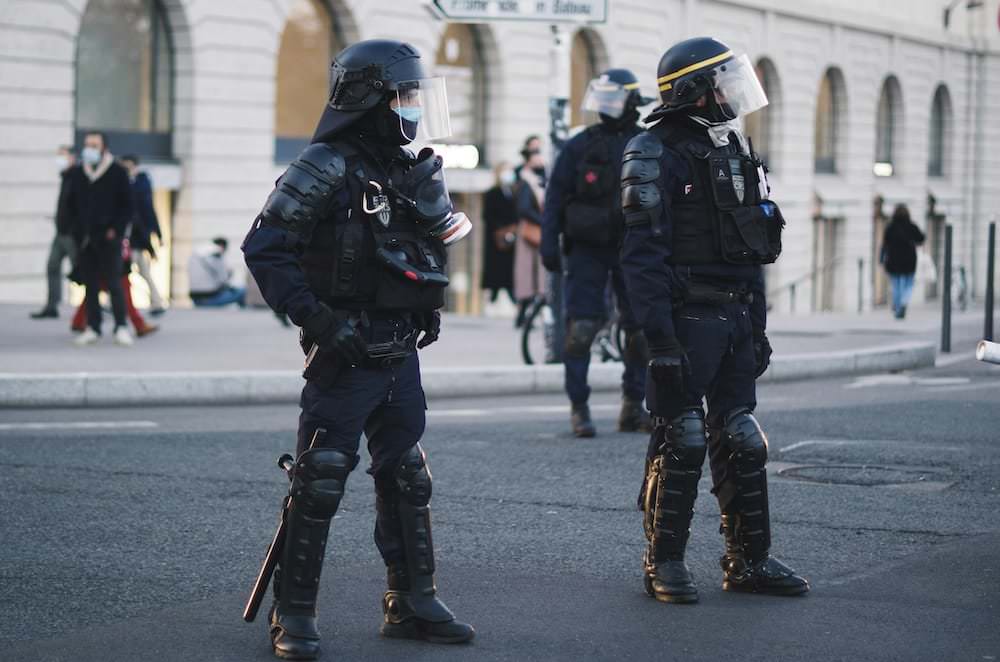
2.2. Les CRS (Compagnies Républicaines de Sécurité)
- A special branch of the Police nationale
- Specializes in riot control and crowd management
- Present during protests, demonstrations, and large events
They are trained for high-risk and tense public situations.
2.3. La Douane (Customs Service)
- Controls borders, airports, ports
- Prevents illegal goods entering the country (e.g. drugs, weapons, counterfeit items)
- Enforces customs and tax laws
- Customs officers are called les douaniers / les douanières
Vocabulary tip:
- Une saisie = a seizure (of illegal goods)
- Le trafic de drogue = drug trafficking
- La contrebande = smuggling
3. Civilian vs. Military Forces
One unique feature of the French system is the coexistence of civilian and military police.
| Police nationale | Gendarmerie nationale | |
|---|---|---|
| Type | Civilian | Military |
| Area of operation | Cities and towns | Rural areas and small towns |
| Officers called | policiers | gendarmes |
| Reports to | Ministry of the Interior | Ministry of the Interior / Defense |
| Special forces units | RAID, BRI, PJ | GIGN, PSIG |
4. Cooperation and Shared Work
Although they come from different traditions, the Police nationale and the Gendarmerie nationale often work together. For example:
- In suburban zones where their areas overlap
- During major emergencies or large-scale operations
- In sharing intelligence and resources
Reforms have helped improve coordination and efficiency between forces. Today, there are joint operations centers and integrated national security strategies.
5. Police & French society
The French police system has roots in centralized state authority dating back to the monarchy and reinforced during the Napoleonic era. This historical legacy created a police force primarily designed to maintain state authority rather than serve communities, a foundation that still influences modern perceptions.
Public opinion surveys consistently show a complex picture:
- General respect for the police institution itself
- Significant variations in trust levels across different demographics
- Lower trust levels in urban areas, particularly in economically disadvantaged neighborhoods
- Higher trust levels in rural areas where the Gendarmerie operates
According to recent surveys, approximately 66% of French citizens express trust in their police forces overall, but this figure drops significantly in certain communities.
6. Summary
| Force | Main Role | Where They Work |
|---|---|---|
| Police nationale | Urban law enforcement and investigations | Cities and towns |
| Gendarmerie nationale | Rural policing and military functions | Countryside and overseas |
| Police municipale | Local safety, minor infractions | Cities and towns |
| CRS | Riot and crowd control | Nationwide |
| Douane | Border control and customs enforcement | Borders, ports, airports |