New Year
France marks the transition from one year to the next with practices that differ in several respects from those of English-speaking countries. Many customs emphasise well-wishing, sociability, and extended greeting periods.
New Year’s Eve: la Saint-Sylvestre
The evening of 31 December is la Saint-Sylvestre. Celebrations focus on a festive dinner known as le réveillon de la Saint-Sylvestre. Typical elements include seafood, foie gras, sparkling wine, and long meals with friends or family.
Compared with Anglo-Saxon contexts, there is less emphasis on the countdown as a public event and more on the shared meal. Public celebrations exist in cities, but private gatherings remain the core practice.
Usage examples
• Nous faisons le réveillon de la Saint-Sylvestre chez des amis.
We are having the New Year’s Eve dinner at friends’ place.
• Ils vont fêter la Saint-Sylvestre à la maison.
They are going to celebrate New Year’s Eve at home.
• On ouvre les bouteilles juste avant minuit.
We open the bottles just before midnight.
Midnight greetings: Bonne année and Bonne santé
At midnight, people wish Bonne année and often Bonne santé. These two greetings are central. French speakers may kiss on the cheek (faire la bise) depending on their relationship.
Anglo-Saxon greetings tend to occur only around midnight and on 1 January. In France, the well-wishing period is far longer.
Usage examples
• Bonne année et bonne santé.
Happy New Year and good health.
• On se souhaite la bonne année dès minuit.
We wish each other a happy new year as soon as it is midnight.
The carte de vœux
The carte de vœux is a New Year greeting card sent throughout January. Unlike Anglo-Saxon Christmas cards, which are usually posted before Christmas, French greeting cards customarily contain New Year wishes and may be sent until 31 January without being considered late.
Cards traditionally express wishes for health, success, or happiness. Digital greetings remain common, but postal cards are still used, especially among older generations, businesses, and formal contacts.
Usage examples
• J’envoie toujours mes cartes de vœux pendant la première semaine de janvier.
I always send my New Year cards during the first week of January.
• Ils ont reçu une carte de vœux de leurs voisins.
They received a New Year card from their neighbours.
• Elle prépare ses cartes de vœux pour ses clients.
She is preparing her New Year cards for her clients.
The extended greeting period
French speakers may offer New Year greetings throughout January, particularly in professional settings. Wishing someone Bonne année in person, by email, or by message is normal well after 1 January. This differs from English-speaking contexts, where greetings usually stop after the first few days of January.
Usage examples
• Bonne année, je vous souhaite une excellente reprise.
Happy New Year, I wish you an excellent return to work.
• Je peux encore te souhaiter la bonne année ?
Can I still wish you a happy new year?
• Il a envoyé ses vœux à toute l’équipe mi-janvier.
He sent his New Year wishes to the whole team in mid-January.
New Year’s Day: quiet or family-oriented
1 January, le jour de l’An, is a public holiday. Many shops and services close. The day is often calm, used for rest after the previous night’s celebration. Family meals occur, but the day is generally simpler than Christmas.
Compared with Anglo-Saxon contexts with televised parades, sporting events, or family brunches, French New Year’s Day is usually low-key.
Usage examples
• Le jour de l’An, on reste souvent à la maison.
On New Year’s Day, people often stay at home.
• Ils déjeunent en famille pour le jour de l’An.
They have lunch as a family on New Year’s Day.
New Year’s resolutions
Resolutions exist in France but play a less prominent cultural role than in English-speaking countries. They are often framed informally, and many people skip them.
Usage examples
• Ma résolution pour cette année est de faire plus de sport.
My resolution for this year is to exercise more.
• Il ne prend jamais de résolutions.
He never makes resolutions.
Gift-giving traditions
Gifts are usually reserved for Christmas, not New Year’s Eve. In some families, small symbolic gifts may appear, but the practice is not widespread. In business settings, companies sometimes send cadeaux d’entreprise in late December or early January.
Usage examples
• Ils n’offrent pas de cadeaux pour le jour de l’An.
They do not give gifts for New Year’s Day.
• L’entreprise envoie des cadeaux pour remercier ses partenaires.
The company sends gifts to thank its partners.
Public events and fireworks
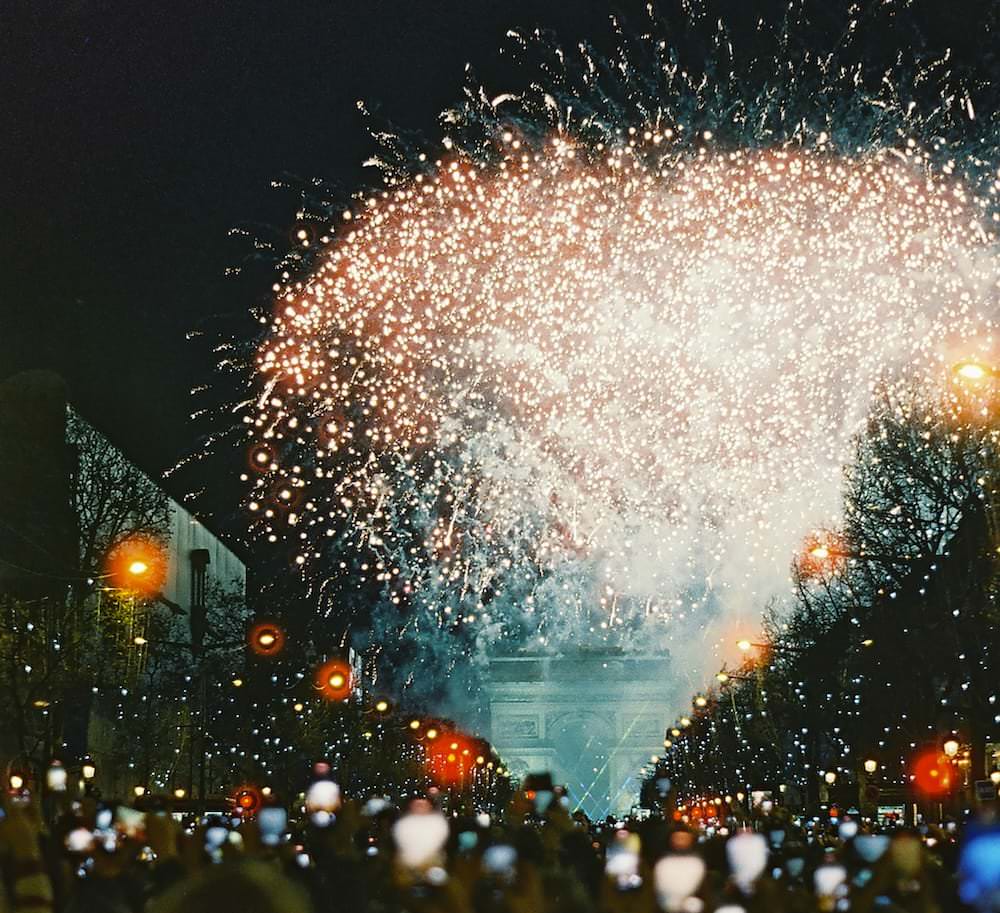
Major cities such as Paris may feature light displays or fireworks, but France does not have a uniform national tradition of public fireworks on New Year’s Eve, unlike places such as London, Sydney, or New York. Many celebrations remain private.
Usage examples
• Il y a un feu d’artifice sur l’avenue des Champs-Élysées.
There is a fireworks display on the Avenue des Champs-Élysées.
• Dans mon village, il n’y a pas de célébration publique.
In my village, there is no public celebration.
Expressions to know
• Le réveillon de la Saint-Sylvestre = New Year’s Eve dinner
• La Saint-Sylvestre = New Year’s Eve
• Le jour de l’An = New Year’s Day
• La carte de vœux = New Year (or holiday) greeting card
• Les vœux = good wishes
• Souhaiter la bonne année = to wish someone a happy new year
• Présenter ses vœux = to offer one’s wishes (formal)
Summary
French New Year traditions emphasise shared meals on New Year’s Eve, repeated greetings throughout January, and the use of the carte de vœux instead of Christmas cards. Public celebrations exist but are secondary to private gatherings. New Year’s Day is usually quiet. Compared with Anglo-Saxon practices, the French approach relies more on extended well-wishing and less on large public countdown events or early card-sending.