Franchir le Rubicon

“Franchir le Rubicon” means to cross the Rubicon. It means to take a decisive and irreversible step, to take a decision and accept all its consequences, to make an irreversible choice, or to take an irrevocable decision.

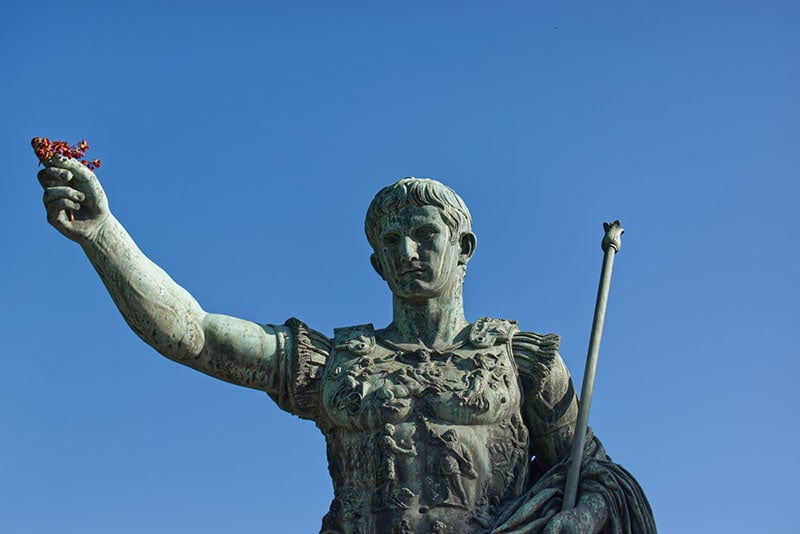
The Rubicon is a river that in 49 BC separated Gaul from the Roman Empire. Julius Caesar, the great Roman general, had just conquered and subdued the Gauls. He was returning to Rome, which was then ruled by Pompey. Pompey had ordered that any general returning to Rome must enter Rome without his army, because Pompey feared a military coup.

Caesar should have dissolved his army at the border of Gaul and the Roman Empire, but he decided to disobey the rule and cross the Rubicon with his men. Upon deciding to do so, he announced fatalistically, “iacta alea est” (Latin for “the die is cast”), meaning that he and his men would now take their chances against Pompey and the might of Rome.

As Caesar and his army marched towards Rome, Pompey fled the city. Eventually, in 48 BC, Caesar and Pompey and their two armies clashed at Pharsalos. Pharsalos, now called Farsala, is a town in Greece, but in 49 BC it was part of the Roman Empire. Pompey’s army vastly outnumbered Caesar’s, with Pompey’s numbering somewhere between 36,000 and 45,000 men.

Despite the numerical disadvantage, Caesar thrashed Pompey’s army. Pompey fled his own camp disguised as an ordinary man, instead of as the general and statesman he was. So at this stage, Caesar’s gamble in crossing the Rubicon had paid off.

Don’t miss out on new posts – subscribe now!

Don’t miss new articles!

Get 1 email a week with new articles about French

We don’t spam! Read more in our privacy policy

Similar Posts

  • bec et ongles

    The French saying “bec et ongles” derives its origin from the Latin expression “rostrum et unguibus,” which also means “beak and nails.” This ancient phrase refers to the beak, symbolizing the fierceness and determination of a bird, and the nails, representing strength and tenacity. Throughout history, birds have often been associated with bravery and courage,…

  • chacun son truc

    Understanding “Chacun son truc” “Chacun son truc” is a common French expression that translates to “to each their own” or “everyone has their thing.” It conveys the idea that everyone has their own preferences, tastes, or ways of doing things. This phrase is often used to express tolerance or acceptance of different behaviors or choices….

  • avoir la dent dure

    French is full of colorful expressions that don’t always have obvious meanings at first glance. One such expression is “avoir la dent dure”, which literally translates to “to have a hard tooth.” Its figurative meaning, however, is quite different. Meaning and Origin of the Expression The expression “avoir la dent dure” is used to describe…

  • passer l’éponge

    Passer l’éponge means literally to pass the sponge, but in slightly better English it would be to wipe the sponge. The English saying it most closely resembles would be “to wipe the slate clean.” It means to restart from zero, to forgive, or to forget disagreeable acts. The expression dates back to the start of…

  • cinquième colonne

    “Cinquième colonne” is a French idiom that means “fifth column.” It translates as “traitor, enemy spy organisation, spy, or secret service for a foreign country.” The idiom dates back to 1936, during the Spanish Civil War. The Nationalists of General Franco announced that the capital of Spain, Madrid, would be attacked by five columns of…