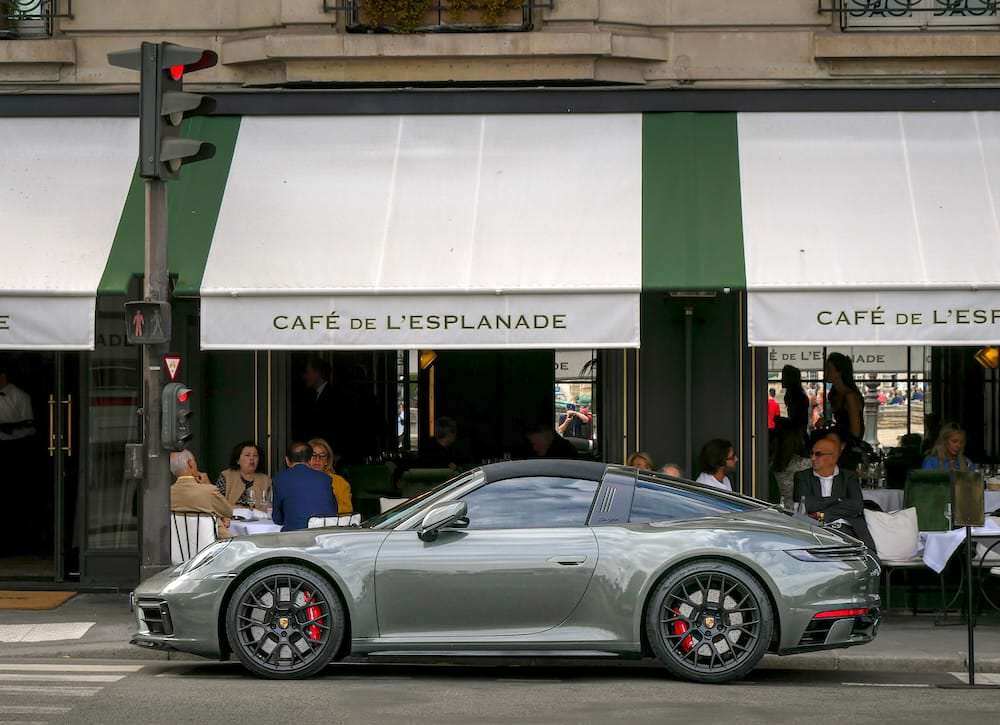
rien à voir

meaning

Rien à voir means “nothing to do with” or “not related.”
It shows that two things are separate, not connected, or not alike.

usage

Use it when someone thinks two things are linked but they are not.
Use it to change the subject or to reject a comparison.

The full form is il n’y a rien à voir, but spoken French drops the il n’y a.
The phrase stays the same for all subjects.

examples

  • Ce film est bizarre, mais rien à voir avec l’horreur.
    “This film is strange, but it has nothing to do with horror.”
  • Tu compares le vin français et le vin chilien ? Rien à voir.
    “You are comparing French wine and Chilean wine? No relation.”
  • Son nouveau travail est mieux payé. Rien à voir avec l’ancien.
    “His new job pays better. Nothing like the old one.”
  • J’aime ce restaurant. Mais rien à voir avec le prix.
    “I like this restaurant. But it has nothing to do with the price.”
  • On parle de politique ? — Non, rien à voir.
    “Are we talking politics? — No, not at all.”
  • Cette voiture rapide ? Rien à voir avec la mienne.
    “That fast car? Nothing like mine.”

synonyms

  • pas du même ordre – “not in the same league”
  • sans rapport – “without connection”
  • différent – “different”
  • ça n’a rien à voir – longer but same meaning
  • aucun lien – “no link”

In casual speech: rien à foutre means “nothing to do with it” but with a rude tone. Avoid it in polite company.

summary

Rien à voir says two things are not connected.
It works for comparisons, misunderstandings, or changing topics.
It is common in everyday French, spoken and written.


Don’t miss new articles!

Get 1 email a week with new articles about French

We don’t spam! Read more in our privacy policy

Similar Posts

  • autant dire

    Autant dire is a fixed French expression used to present a conclusion as obvious, inevitable, or practically equivalent to what has just been stated. It signals that the speaker considers the inference self-evident and not worth elaborating further. In English, it is often rendered as “which is to say,” “so basically,” “that’s pretty much the…

  • -ty becomes té in French

    English has many words that end in “ty,” like liberty, beauty, and certainty, and they almost all come from French. The French versions end in “té” instead, so liberty becomes la liberté, beauty becomes la beauté, and certainty becomes la certitude. The pattern is simple for most of them: you just drop the “y” from…

  • on

    The French pronoun “on” is one of the most versatile and frequently used words in the French language. Its various meanings and uses make it an essential part of everyday speech. Meanings and uses of “on” 1. Indefinite subject: “someone” or “people” 2. General statements: “we,” “you,” or “they” 3. As a replacement for “nous”…

  • vivre vs habiter

    Both vivre and habiter mean “to live” in French, but they are used in slightly different contexts. 1. Vivre – “To live” (in a broader sense) 2. Habiter – “To reside” (more specific) Key Difference: In everyday conversation, habiter is more common when talking about where someone lives physically, while vivre is used for broader…

  • reflexive verbs imperative

    The imperative mood in French is used to give commands, make requests, or offer advice. When using reflexive verbs (verbes pronominaux) in the imperative, the word order and placement of reflexive pronouns change depending on whether the command is affirmative or negative. 1. Affirmative Imperative with Reflexive Verbs In affirmative commands, the reflexive pronoun follows…