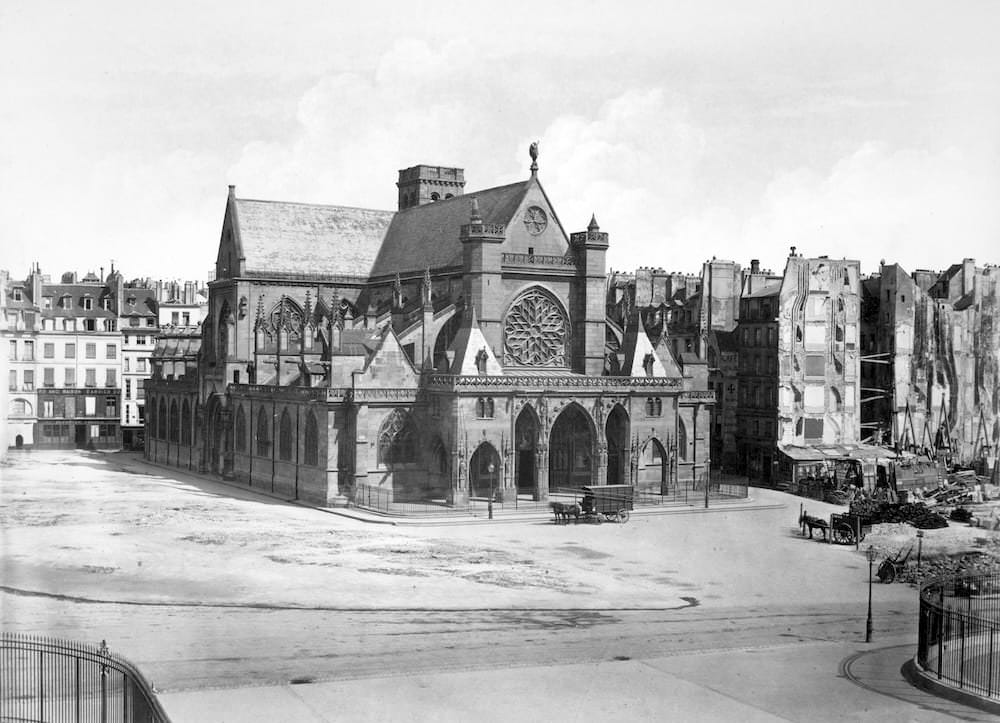
La Saint-Barthélemy
In French history, « la Saint-Barthélemy » refers not to a feast day but to a massacre. On 24 August 1572, during the religious wars between Catholics and Protestants (Huguenots), thousands of Protestants were killed in Paris and across France. The event remains one of the most infamous episodes in the French Wars of Religion and a symbol of religious intolerance.
Background: France Divided by Faith
The mid-16th century was a period of deep religious division in France. The Protestant Reformation had spread rapidly, attracting members of the nobility and the educated classes. The Catholic monarchy, led at the time by King Charles IX and his mother, Catherine de Médicis, faced repeated uprisings and civil wars between Catholic and Protestant factions.
In an attempt to reconcile the two sides, Catherine arranged the marriage of her daughter Marguerite de Valois (a Catholic) to the Protestant leader Henri de Navarre (the future Henri IV). The wedding took place in Paris in August 1572, with many prominent Huguenots attending.
The Massacre Begins
Only days after the wedding, an attempt was made on the life of Admiral Gaspard de Coligny, one of the main Protestant leaders. The failed assassination raised tensions to breaking point.
In the early hours of 24 August, the Feast of Saint Bartholomew, mobs of Parisians—encouraged by radical Catholic leaders—began killing Protestants throughout the city. The violence quickly spread to other towns such as Orléans, Lyon, and Toulouse.
Estimates vary, but historians believe that between 5,000 and 10,000 people were killed across France, with roughly 2,000 in Paris alone.
Consequences
The massacre shocked Europe. It destroyed hopes of religious reconciliation and intensified the wars that would continue for another two decades.
Henri de Navarre, who had been forced to convert to Catholicism to save his life, later reconverted to Protestantism and eventually became King Henri IV. In 1598, he sought to restore peace with the Edict of Nantes, granting limited religious freedom to Protestants.
The memory of the Saint Bartholomew’s Day Massacre remained a powerful symbol of fanaticism, betrayal, and political manipulation. In French political and literary history, “la Saint-Barthélemy” became shorthand for mass violence justified by ideology.
Cultural and Linguistic Legacy
Today, the phrase « la Saint-Barthélemy » is still used metaphorically in French to describe a brutal collective purge or political bloodbath, for example:
Les licenciements massifs ont été une véritable Saint-Barthélemy dans l’entreprise.
“The mass layoffs were a real St. Bartholomew’s Day massacre in the company.”
Writers such as Alexandre Dumas, Voltaire, and Jules Michelet revisited the event as an example of human cruelty and the dangers of intolerance. Historians still debate Catherine de Médicis’s exact role, but the massacre’s symbolic power has never faded.
In short:
La Saint-Barthélemy stands as one of the darkest chapters in French history — a reminder of how fear and fanaticism can destroy a nation from within, and how fragile peace can be when faith and power collide.