
to collapse
The English verb “to collapse” has several French translations. The right choice depends on what falls, fails, gives way, or is made smaller. For a building or a person, s’effondrer and s’écrouler are common. For plans or talks that fail, French often uses échouer or tomber à l’eau.
Buildings and other structures
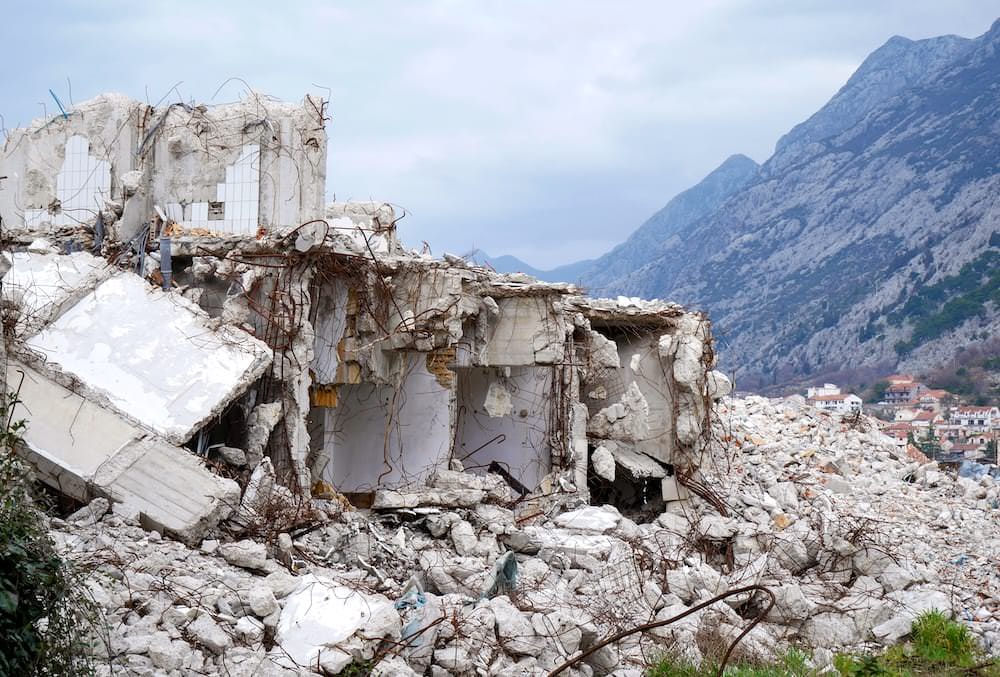
Use s’effondrer or s’écrouler when a building, wall, bridge, roof, or other structure falls down. Both are common. S’effondrer also works well for a structure that caves in.
- Le vieux pont s’est effondré pendant la tempête. – “The old bridge collapsed during the storm.”
- Une partie du toit s’est écroulée sous le poids de la neige. – “Part of the roof collapsed under the weight of the snow.”
- Le mur s’est effondré après le choc. – “The wall collapsed after the impact.”
- La mine s’est écroulée. – “The mine collapsed.”
These verbs are reflexive in this use: the subject is the thing that falls down. French uses s’effondrer and s’écrouler, not a direct equivalent of “the building collapsed” without se.
People who fall, faint, or lose strength
For a person who falls from weakness or exhaustion, use s’effondrer or s’écrouler. The exact meaning depends on the setting. If someone faints or has a sudden spell of illness, faire un malaise is often more precise.
- Il s’est effondré de fatigue en rentrant chez lui. – “He collapsed from exhaustion when he got home.”
- Elle s’est écroulée sur le canapé. – “She collapsed on the sofa.”
- Il a fait un malaise dans la rue. – “He collapsed in the street.”
- Après la course, les joueurs se sont effondrés sur l’herbe. – “After the race, the players collapsed on the grass.”
For an emotional collapse, s’effondrer is also common.
- Elle s’est effondrée en apprenant la nouvelle. – “She broke down when she heard the news.”
- Il s’est effondré en larmes. – “He broke down in tears.”
- Après des mois de stress, il a fini par craquer. – “After months of stress, he finally broke down.”
Here, craquer is a less formal alternative. It means that someone gives way under pressure, not that they physically fall.
Plans, talks, and systems that fail
When a plan, deal, meeting, or set of talks does not succeed, French often uses échouer or tomber à l’eau. For a government, business, or system that breaks down, s’effondrer may fit.
- Les négociations ont échoué. – “The talks collapsed.”
- L’accord est tombé à l’eau. – “The deal fell through.”
- Le projet s’est effondré après le départ de son principal soutien. – “The project collapsed after its main backer left.”
- Le gouvernement est tombé après le vote. – “The government fell after the vote.”
- Le système bancaire s’est effondré. – “The banking system collapsed.”
Tomber à l’eau is an informal expression, often used when a plan or event is abandoned or cannot go ahead.
Markets and prices
For a market, share price, or value that drops sharply, use s’effondrer. For a smaller or more general drop, baisser or chuter may be better.
- Les cours de la bourse se sont effondrés. – “Stock prices collapsed.”
- Le prix du pétrole a chuté en quelques jours. – “The price of oil fell sharply in a few days.”
- La valeur de la maison a baissé. – “The value of the house fell.”
A body part or object that gives way
For something that bends, sinks, or loses its shape, use s’affaisser. It can describe a body part, a surface, or a structure that sags rather than falls apart.
- Le plancher s’est affaissé sous son poids. – “The floor gave way under his weight.”
- La vieille chaise s’est affaissée. – “The old chair sagged.”
- Son poumon s’est affaissé. – “His lung collapsed.”
Making something smaller or combining it
English “to collapse” can also mean to hide details in a menu or document, or to bring several things together. In these cases, French uses other verbs.
For a menu, section, or list that can be opened and closed, use réduire or replier. For combining several things into one, use fusionner or regrouper.
- Cliquez ici pour réduire la section. – “Click here to collapse the section.”
- Repliez le menu avant de continuer. – “Collapse the menu before you continue.”
- Les deux entreprises ont fusionné. – “The two companies merged.”
- Le rapport regroupe plusieurs tableaux en un seul. – “The report combines several tables into one.”
Quick guide
- A building, roof, or wall falls down: s’effondrer or s’écrouler.
- A person falls from exhaustion or emotion: s’effondrer or s’écrouler.
- A person faints or has a sudden spell of illness: faire un malaise.
- A plan or deal fails: échouer or tomber à l’eau.
- A market or system fails sharply: s’effondrer.
- Something sags or gives way: s’affaisser.
- A menu or section is hidden: réduire or replier.
- Separate things become one: fusionner or regrouper.
Summary
French does not use one verb for every meaning of “to collapse.” Use s’effondrer or s’écrouler for a structure or person that falls, faire un malaise for fainting, and échouer or tomber à l’eau for plans that fail. For other uses, such as a menu that closes or things joined into one, choose a verb that names the specific action.