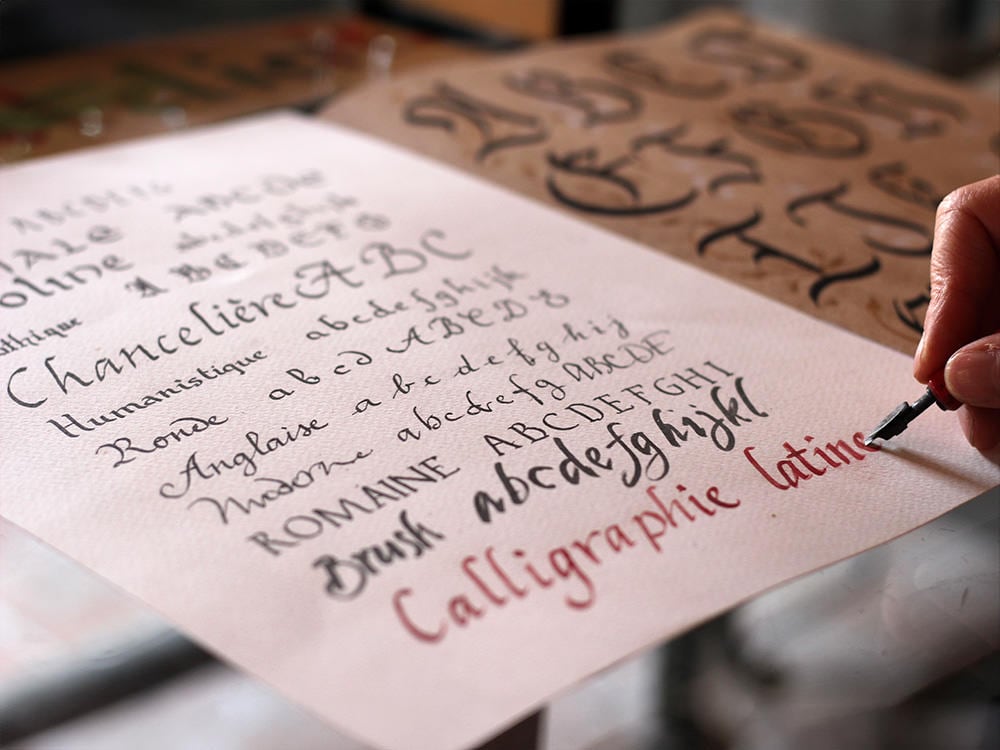
verb: écrire
The French verb “écrire” means “to write.”
Conjugation
- Present Tense: “Écrire” is an irregular verb that is conjugated irregularly in the present tense.
- J’écris (I write)
- Tu écris (You write)
- Il/elle/on écrit (He/she/one writes)
- Nous écrivons (We write)
- Vous écrivez (You write)
- Ils/elles écrivent (They write)
- Past Tense (Passe Composé): In the past tense, “écrire” is also irregular and is conjugated with the auxiliary verb “avoir.” The past participle of “écrire” is “écrit.”
- J’ai écrit (I wrote)
- Tu as écrit (You wrote)
- Il/elle/on a écrit (He/she/one wrote)
- Nous avons écrit (We wrote)
- Vous avez écrit (You wrote)
- Ils/elles ont écrit (They wrote)
Homologues
The French language has several verbs that share the same suffix “-crire,” making them homologues of “écrire.” These verbs are also irregular and conjugated similarly to “écrire.” They often revolve around the concept of writing or describing.
- Circonscrire: To confine or limit, often in a precise or defined area.
Example: Les autorités ont circonscrit la zone de quarantaine. (The authorities confined the quarantine area.) - Décrire: To describe, depict, or narrate in detail.
Example: Il a bien décrit le paysage dans son roman. (He described the landscape well in his novel.) - Inscrire: To enroll, register, or write something in a record or list.
Example: Les étudiants doivent s’inscrire pour les cours en ligne. (Students need to enroll for online courses.) - Prescrire: To prescribe, typically referring to medical prescriptions.
Example: Le médecin a prescrit des antibiotiques. (The doctor prescribed antibiotics.) - Proscrire: To prohibit or ban.
Example: La loi a proscrit la vente d’alcool aux mineurs. (The law banned the sale of alcohol to minors.) - Récrire: To rewrite or transcribe.
Example: L’auteur a dû récrire le premier chapitre de son livre. (The author had to rewrite the first chapter of his book.) - Souscrire: To subscribe or endorse, often in the context of agreements or financial matters.
Example: Il a souscrit à un abonnement mensuel. (He subscribed to a monthly plan.) - Transcrire: To transcribe or copy in writing.
Example: Le secrétaire a dû transcrire les notes du discours. (The secretary had to transcribe the speech notes.)
Etymology
The word “écrire” comes from the Latin word “scribere.” “Scribere” means “to write” in Latin and is the source of the French verb “écrire.” Over time, the word “scribere” evolved into “escrire” or “escrivre” in Old French (11th century), and eventually took on its modern spelling “écrire.”