Christmas traditions
French Christmas traditions differ in several important ways from Anglo-Saxon customs. Many celebrations occur on Christmas Eve rather than Christmas Day, food traditions follow established regional patterns, and several symbolic elements remain strongly tied to family gatherings and shared meals. The focus is often on the evening feast, seasonal desserts, and the cultural role of the sapin de Noël.
Christmas Eve celebrations
In most of France, the main celebration takes place on 24 December. Families gather for the réveillon, an evening meal that can last late into the night. Children often open presents either before midnight or early on Christmas morning, depending on the family.
Key differences from Anglo-Saxon traditions:
• The main festive meal usually occurs on Christmas Eve, not Christmas Day.
• Gift opening frequently takes place on Christmas Eve.
• The day of 25 December is quieter, often centred on a family lunch.
Usage examples:
• On se réunit pour le réveillon chez mes parents.
We are meeting for Christmas Eve at my parents’ place.
• Les enfants ont ouvert leurs cadeaux le soir du 24.
The children opened their presents on the evening of the 24th.
• Le repas du réveillon dure des heures.
The Christmas Eve meal lasts for hours.
The réveillon (Christmas Eve) meal
The réveillon is central to French Christmas. The meal is long, elaborate, and structured around specific seasonal ingredients.
Typical dishes include:
• oysters
• foie gras
• smoked salmon
• roast poultry, often capon or turkey
• chestnuts
• regional dishes such as coquilles Saint-Jacques, gratin dauphinois, or chapon farci
Differences from Anglo-Saxon customs:
• Seafood plays a larger role than in many English-speaking countries.
• The meal is more formal and often multi-course.
• Many families serve foie gras, which is not common in Anglosaxon celebrations.
• Christmas crackers, common in the UK, are not part of French Christmas tables.
Usage examples:
• On commence le réveillon avec des huîtres et du saumon fumé.
We begin the Christmas Eve meal with oysters and smoked salmon.
• Ils préparent un chapon farci pour toute la famille.
They are preparing a stuffed capon for the whole family.
• Le foie gras est presque obligatoire pour le réveillon.
Foie gras is almost obligatory for Christmas Eve.
The bûche de Noël (Yule log cake)
The bûche de Noël is the traditional Christmas dessert. It takes the form of a rolled sponge cake filled with cream, decorated to resemble a log. It reflects the historical custom of burning a large log in the fireplace to protect the home for the coming year.
Varieties include:
• classic buttercream
• chestnut cream
• chocolate mousse
• frozen versions (bûches glacées)
Differences from Anglo-Saxon customs:
• The bûche de Noël is more central than Christmas pudding or fruitcake.
• French Christmas desserts tend to be lighter and more patisserie-based.
• Few families serve heavy spiced cakes or steamed puddings.
Usage examples:
• On a commandé une bûche de Noël au chocolat.
We ordered a chocolate Christmas log.
• Ils terminent toujours le repas avec une bûche traditionnelle.
They always finish the meal with a traditional log cake.
• Cette année, ils ont préparé une bûche glacée.
This year they made a frozen log.
The sapin de Noël (Christmas tree)
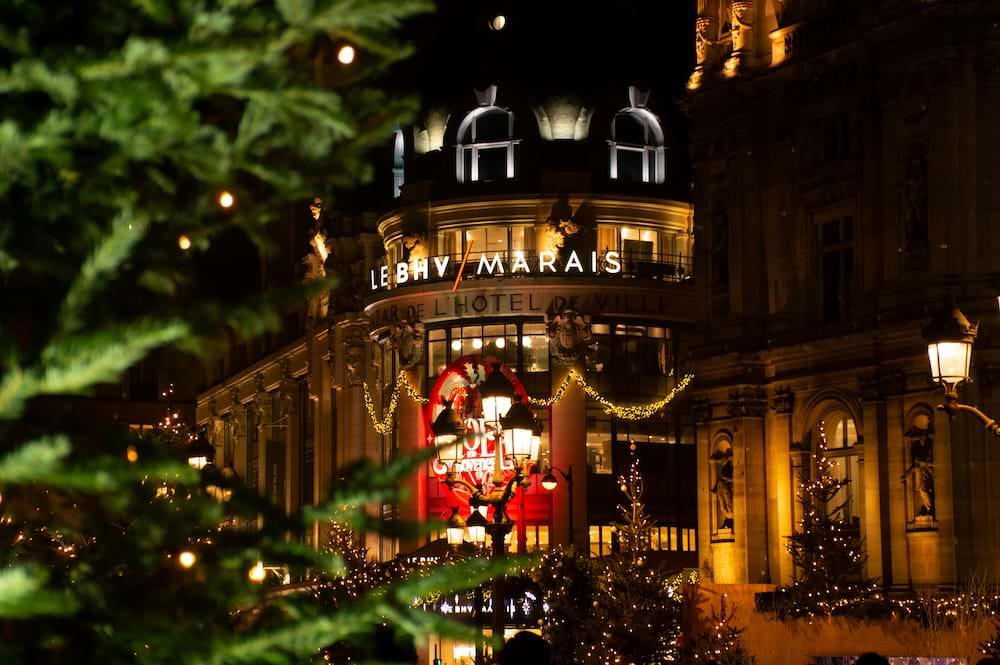
The sapin de Noël (“fir tree of Christmas”) is central to household decoration. Families often decorate it in early December or just before Christmas, depending on regional custom. Decorations include lights, baubles, stars, and garlands.
Key differences from Anglo-Saxon customs:
• Tinsel is less common in France than in English-speaking countries.
• Many families prefer white lights to coloured ones.
• Nativity scenes (crèches) are common in Provence and sometimes occupy a place of honour, featuring small clay figurines known as santons.
Usage examples:
• On a décoré le sapin de Noël le premier week-end de décembre.
We decorated the Christmas tree on the first weekend of December.
• La crèche reste sous le sapin jusqu’à l’Épiphanie.
The nativity scene stays under the tree until Epiphany.
• Les enfants accrochent des boules rouges et dorées au sapin.
The children hang red and gold baubles on the tree.
Religious and cultural elements
While France is largely secular, some families attend la messe de minuit on Christmas Eve. For many others, the holiday remains cultural rather than religious.
Differences from Anglo-Saxon customs:
• Fewer families attend church compared to countries with stronger religious observance.
• The midnight mass tradition survives mainly in rural areas or practising Catholic families.
Usage examples:
• Ils vont à la messe de minuit avant le réveillon.
They go to midnight mass before the Christmas Eve meal.
• Beaucoup de familles ne font plus la messe de minuit.
Many families no longer attend midnight mass.
Gift giving
Père Noël is the French figure corresponding to Santa Claus. Children sometimes leave shoes by the fireplace for small gifts.
Differences from Anglo-Saxon customs:
• Stockings are less common; shoes are traditional.
• Letters to Père Noël are answered by a national postal service programme.
• Gifts are frequently opened on Christmas Eve rather than Christmas morning.
Usage examples:
• Les enfants ont laissé leurs chaussures devant la cheminée pour le Père Noël.
The children left their shoes in front of the fireplace for Father Christmas.
• Ils ouvrent les cadeaux après le réveillon.
They open the presents after the Christmas Eve meal.
Regional traditions
Different areas have additional customs. For example, Provence celebrates the “thirteen desserts,” a selection of sweets representing biblical symbolism. Alsace is known for spiced biscuits and strong Germanic influence in decorations.
Differences from Anglo-Saxon customs:
• The “thirteen desserts” tradition has no equivalent in English-speaking countries.
• Alsatian gingerbread is softer and less heavily spiced than British gingerbread.
Usage examples:
• En Provence, on sert les treize desserts après le repas.
In Provence, the thirteen desserts are served after the meal.
• En Alsace, ils préparent des bredeles.
In Alsace, they prepare small spiced biscuits.
Summary
• French Christmas centres on Christmas Eve rather than Christmas Day.
• The réveillon, seafood dishes, foie gras, and the bûche de Noël are important parts of the celebration.
• Decorations emphasise the sapin de Noël and sometimes a crèche.
• Gift giving often takes place on the evening of 24 December.
• Traditions vary across regions, especially in Provence and Alsace.